
DevOps Workflow for Web Applications: A Roadmap for Fast, Secure, and Stable Deployment
In the hyper-competitive digital landscape of 2026, the ability to release new features rapidly without destabilizing the system is the ultimate competitive advantage. To achieve this balance, implementing a structured DevOps workflow for web applications is no longer optional—it is mandatory for modern enterprises.
At SEA-Solutions, a leader in Vietnam software development, we view DevOps as a collaborative culture that optimizes the entire lifecycle. This article provides a deep dive into the core phases of a world-class DevOps workflow for web applications, helping you automate infrastructure and elevate quality.
Table of Contents
1. Planning: The Foundation of a DevOps Workflow for Web Applications
The first phase of a high-performing DevOps workflow for web applications is not just about writing code; it is about creating a blueprint that ensures scalability and traceability. Without a disciplined start, the automation in later stages will only speed up the delivery of errors.
A. Strategic Planning & Architectural Alignment
DevOps bridges the gap between “what we want to build” and “how it will run.” This requires Shift-Left Planning:
Infrastructure-First Thinking: Teams collaborate during the planning phase to define the environment (e.g., Docker containers).
Tooling Selection: Choosing the right stack is vital. Refer to our guide on Top 5 DevOps tools 2026 for Web Applications to find tools like Jira or Terraform.
B. Source Code Management (SCM) with Git Flow
Code is the single source of truth. A professional SCM strategy ensures multiple developers can contribute without overwriting work.
- Branching Strategy (Git Flow): We isolate work in Feature Branches, use a Develop Branch for integration, and keep the Main Branch strictly production-ready.
- Code Review & Pull Requests (PRs): No code moves forward without peer review, acting as the first line of defense for quality.
2. CI: The Engine of a DevOps Workflow for Web Applications
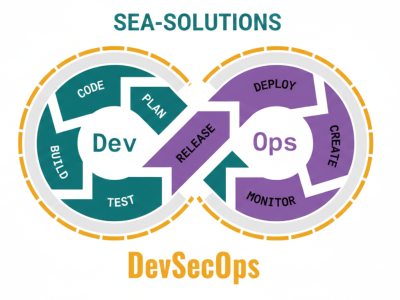
Continuous Integration (CI) is the practice of automating the integration of code changes daily, allowing for immediate detection of errors.
A. The Automated Build Trigger
The CI process begins the moment a developer pushes code. The CI server (like GitHub Actions or Jenkins) triggers an automated “Build” in a clean environment, often packaging the app into Docker containers for consistency.
B. Automated Testing: The First Line of Defense
Testing is an automated gate within the CI pipeline. Unit & Integration Tests verify that individual functions and component interactions work as expected. If a test fails, the build is marked “failed” instantly.
C. Automated Code Quality
CI enforces coding standards through automated linting and early-stage vulnerability scanning. Mastering how to automate CI/CD with GitHub Actions is essential to eliminate these manual tasks.
3. Integrating Security into Your DevOps Workflow for Web Applications
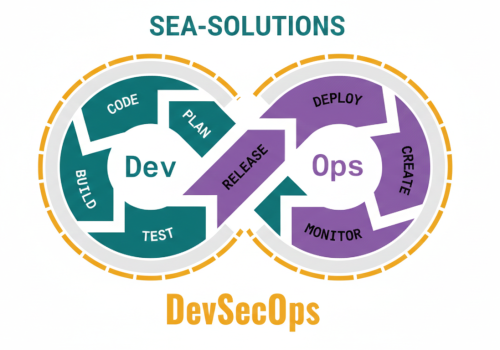
In traditional development, security was the “final gate”—a manual audit performed just before production. This often resulted in “bottlenecks.” DevSecOps solves this by “Shifting Left,” moving security testing to the earliest possible stages.
A. The Principle of Shifting Left
Security starts at the Planning and Coding stages. By finding a vulnerability while the developer is still writing the code, the cost of remediation is significantly lower. Security becomes a shared responsibility supported by automated tooling.
B. Automated Security Tooling (SAST & DAST)
- SAST (Static Application Security Testing): Scans source code for vulnerabilities (like SQL Injection) during the Build phase.
- DAST (Dynamic Application Security Testing): Tests the running application in a staging environment, mimicking an outside attacker.
C. Software Composition Analysis (SCA)
Modern web apps rely on thousands of open-source libraries. SCA tools automatically check these dependencies against vulnerability databases (like CVE). If a library is found to have an exploit, the CI/CD pipeline fails the build automatically.
For a deeper dive, see our guide: DevSecOps: Integrating Security into DevOps Pipelines.
4. CD Strategies in a DevOps Workflow for Web Applications
Continuous Deployment (CD) automates the release process, ensuring that every change passing the pipeline reaches customers safely and quickly.
A. High-Availability Release Strategies
To maintain a professional web application, we use Zero-Downtime Deployment techniques:
- Blue-Green Deployment: We flip traffic between two identical environments (Blue for current, Green for new). If an error is found, we flip back instantly.
- Canary Release: We roll out the new version to a small percentage of users (e.g., 5%) first to monitor performance before a full rollout.
B. Automated Rollback: The Safety Net
A critical component of CD is the Automated Rollback. If the pipeline detects a spike in errors or performance drops after a release, it automatically reverts to the last stable version. Explore these strategies in detail: Zero-Downtime Deployment Strategy: Update Web Without Interruption.
The DevOps workflow is an infinite loop where the focus shifts from “building” to Observability.
5. Monitoring: The Loop of a DevOps Workflow for Web Applications
The DevOps workflow is an infinite loop where the focus shifts from “building” to Observability.
A. Full-Stack Observability
We track the “Three Pillars of Observability”:
- Metrics: Quantitative data like CPU/RAM usage and latency.
- Logs: Detailed records of every event, crucial for Root Cause Analysis.
- Traces: Request journeys through microservices to find specific bottlenecks.
B. The Feedback Loop
Monitoring data isn’t just for Ops; it is fed back to the Dev team to prioritize bug fixes and performance optimizations for the next sprint. This cycle ensures the application evolves based on real user behavior rather than assumptions.
Building a robust DevOps workflow for web applications is more than just a technical upgrade—it is a strategic pivot towards agility, security, and long-term stability. By integrating these five core phases—from meticulous planning and automated CI/CD to a proactive “Shift Left” security mindset—your business can bridge the gap between development speed and operational reliability.
In 2026, the companies that thrive are those that can transform feedback into features within hours, not weeks. At SEA-Solutions, we provide the expertise and the automated frameworks necessary to make this a reality. Whether you are looking to optimize your existing pipeline or build a new one from the ground up, our team is committed to delivering excellence through the power of DevOps.
Are you ready to accelerate your software delivery and outpace the competition?
Tags:
Vietnam Software Outsourcing, DevOps Workflow, Web Application, CI/CD, Automation, DevSecOps, Zero-Downtime Deployment, SEA-Solutions, Vietnam Software Outsourcing, Software Development, Agile Transformation