
The 5-Step Web Project Planning Process for Success and Avoiding Early Failure
Effective planning is the most crucial step in any web application development project. Executing a successful web project planning process is essential, as it transforms a simple idea into a structured, executable roadmap. A detailed, clear plan not only provides direction but also serves as a shield, protecting the project from risks and failure right from the initiation phase.
Table of Contents
What Is the Web Project Planning Process?
Web project planning is the initial, crucial phase of the software development lifecycle (SDLC) where the scope, goals, resources, timelines, and technology for building a web application or website are meticulously defined and documented. It transforms a conceptual idea into a structured, executable roadmap, minimizing risks and ensuring the final product meets business objectives.
Core Benefits of a Robust Project Plan
A successful web project is rarely the result of luck; it is the direct outcome of meticulous planning. Investing time upfront in this phase minimizes costly errors, ensures resource efficiency, and guarantees the entire team is aligned. The core advantages of a strong plan include:
| Benefit | Explanation of Importance |
| Saves Cost and Time | Changes made during planning are significantly cheaper and faster than fixing errors after coding begins, protecting your budget and schedule. |
| Mitigates Risks | Planning forces the identification of potential threats (e.g., skill gaps, technology issues) early, allowing for proactive contingency plans. |
| Effective Collaboration | A unified plan acts as a single source of truth, aligning the entire team (developers, designers, clients, stakeholders) toward common goals. |
| Increases Success Rate | By prioritizing only essential features for the MVP, the plan ensures resources are focused on delivering maximum value to the market quickly. |
Why Do You Need the Web Project Planning Process?
The need for a formal Web project planning process stems directly from the complexities and high stakes of modern software development:
To Prevent Scope Creep: Without a defined scope (Step 1), requirements inevitably expand, leading to budget overruns and delayed delivery.
To Ensure Viability: Planning validates if the idea is technically feasible (Step 4) and financially sound before major investment.
To Maintain Quality: Defining requirements and testing criteria (Steps 2 & 5) upfront ensures the final product meets functional and non-functional standards.
To Manage Expectations: A clear roadmap (Step 5) provides transparency to all stakeholders regarding delivery timelines and feature sets.
Step-by-Step Guide: The 5-Step Web Project Planning Process
The web project planning process involves 5 core, sequential steps:
Define Vision and Scope
Requirements Analysis and Feature Mapping
User Experience and Interface Design (UX/UI)
Technology Stack and Architecture Selection
Detailed Project Roadmap and Planning
1️⃣Define Vision and Scope
What Is It? This first stage determines the “Why” and “What” of the project. You must establish the ultimate purpose and the measurable business goals (KPIs) the application aims to achieve. This step defines the boundaries of the solution (what will and won’t be built).
How to Plan The primary activity is documenting the Vision & Goals by writing a clear Mission Statement and defining measurable Business Goals (KPIs). Crucially, this is where you Define the Minimum Viable Product (MVP) by listing only the essential features needed for the first launch.
The Best Way The most effective approach is to Conduct Stakeholder Interviews to align expectations across all parties. To manage the project scope, use a “Parking Lot” approach to move non-essential features to a backlog immediately to prevent Scope Creep.
Tool Suggestions Use documentation tools like Google Docs/Confluence, simple Mind Maps for ideation, and the Lean Canvas template for quick business modeling.
2️⃣Requirements Analysis and Feature Mapping
What Is It? This step translates the high-level scope and goals into specific, actionable functional and non-functional requirements. It is about defining precisely what the system must do and how well it must perform.
How to Plan The core task is to Write User Stories, defining features from the user’s perspective (e.g., “As an admin, I want to approve new users”). Concurrently, you must Map User Flows, creating diagrams that show the step-by-step path a user takes to complete key actions.
The Best Way Adopt the MoSCoW method to prioritize features clearly into Must-have, Should-have, Could-have, and Won’t-have, ensuring resources are focused on the highest value items first. When mapping flows, focus on the most critical user paths.
Tool Suggestions Use Jira or Azure DevOps for User Story Management, and tools like Draw.io, Lucidchart, or Miro for Flowcharting.
3️⃣ User Experience and Interface Design (UX/UI)
What Is It? The focus now shifts to designing the application’s look, feel (UI), and overall usability (UX) to ensure the application is intuitive, efficient, and visually appealing for the end-user.
How to Plan The design process starts by creating Low-Fidelity Wireframes, which are simple structural sketches of each screen layout. These are quickly developed into Interactive Prototypes (High-Fidelity) that visually mimic the final product.
The Best Way Start with Low-Fidelity sketches to test concepts quickly without focusing on aesthetics. The most critical activity is Usability Testing; testing the prototype with a small group of target users is essential to gather early feedback on clarity and ease of use.
Tool Suggestions Start with Pen and Paper or Balsamiq for basic Wireframes, and then use industry-standard tools like Figma, Sketch, or Adobe XD for Prototyping and collaboration.
4️⃣ Technology Stack and Architecture Selection
What Is It? This is the technical decision-making stage where the core programming languages, frameworks, databases, and structural model (architecture) that will power the application are chosen. This impacts performance, security, and scalability.
How to Plan Project leaders must select the core Technology Stack (Frontend, Backend, Database). The selection should be based on a thorough Scalability Assessment, projecting user growth and transaction volume over the next 3-5 years.
The Best Way Always Choose based on Future Goals, opting for an architecture (e.g., Microservices) that supports high growth, even if it adds initial complexity. Furthermore, Standardize Data Exchange by choosing protocols like GraphQL or ODATA for structured API communication.
Tool Suggestions Architectural Diagrams (C4 Model) help visualize the structure, while tools like Postman are essential for API testing and documentation. Cloud provider pricing tools (AWS/Azure/GCP) help assess hosting costs.
5️⃣ Detailed Project Roadmap and Planning
What Is It? This final planning step converts the documented requirements into an executable schedule, allocating resources, defining milestones, and setting up methods to manage the execution and delivery of the project.
How to Plan The team must Break Down Tasks (converting user stories into assignable work items) and define clear quality gates: the Definition of Done (DoD) (when a feature is truly finished) and the Definition of Ready (DoR) (when a task can be started).
The Best Way The best approach is to adopt the Agile Methodology (Scrum), planning work in short, manageable cycles called Sprints. A formal Risk Assessment must be conducted to identify major threats and create mitigation strategies, culminating in a complete project roadmap.
Tool Suggestions Use leading Project Management tools like Jira, Asana, or Monday.com for Sprint Tracking. Maintain a Risk Log (Excel/Confluence) and use tools like Microsoft Project or Google Calendar for overall timeline tracking.
Essential Web Project Planning Checklist
Use this quick checklist to ensure you’ve covered the critical milestones before handing off the project to the development team:
Vision & Scope: Finalized the Mission Statement and approved the MVP feature list.
Requirements: All core features are documented as User Stories and prioritized (MoSCoW).
User Flow: Key user journeys are mapped and bottlenecks identified.
Design: Low-fidelity Wireframes and High-fidelity Prototypes are approved after Usability Testing.
Technology: The final Tech Stack (Frontend, Backend, Database) and Architecture have been selected.
Roadmap: The project is broken down into Sprints with clear resource allocation and a Risk Log created.
SEA: Practical Application of the Web Project Planning Process
At SEA, we understand that project success hinges on meticulous preparation. Our commitment to the rigorous Web project planning process ensures every solution is built on a solid foundation, providing full-stack web application development services, from Planning to Deployment.
SEA's Planning Approach and Success Metrics
We integrate the 5-step process—from Vision Definition to Roadmap Finalization—into our core service model. This means every client engagement starts with an intensive planning phase where our team collaborates to Define Scope (Step 1), execute comprehensive Requirements Analysis (Step 2), and finalize tested UX/UI Prototypes (Step 3) before any code is written. We then systematically select the optimal Technology Stack (Step 4) to ensure long-term scalability and create an Agile Roadmap (Step 5) for transparent, on-time delivery.
This systematic approach consistently achieves measurable results for our clients:
Reduced Development Costs due to minimized rework and preemptive risk mitigation.
Faster Time-to-Market by focusing resources exclusively on essential MVP features.
High User Satisfaction guaranteed by early and iterative testing of UX prototypes.
Case Application: Real Estate Management System
The principles of our robust planning process were recently applied to a large-scale Real Estate Sales and Management System for a Vietnamese client. This project serves as a clear illustration of how detailed planning leads to successful implementation and delivery of a complex multi-platform solution.
1. Define Vision and Scope (Step 1)
Application: The planning team defined the core vision as creating a unified digital platform to accelerate property sales and streamline contract management.
Scope: The MVP was scoped to include 3 core modules: a high-transaction Backend (Admin System), a customer-facing Online Sales Website, and an agent-facing Mobile App for on-the-go access and reservations.
2. Requirements Analysis and Feature Mapping (Step 2)
User Stories: Critical features were defined from the Sales Agent perspective, for example: “As a Sales Agent, I want to filter property stock by contract status (Draft, Signed, Paid) so I can quickly identify available units.”
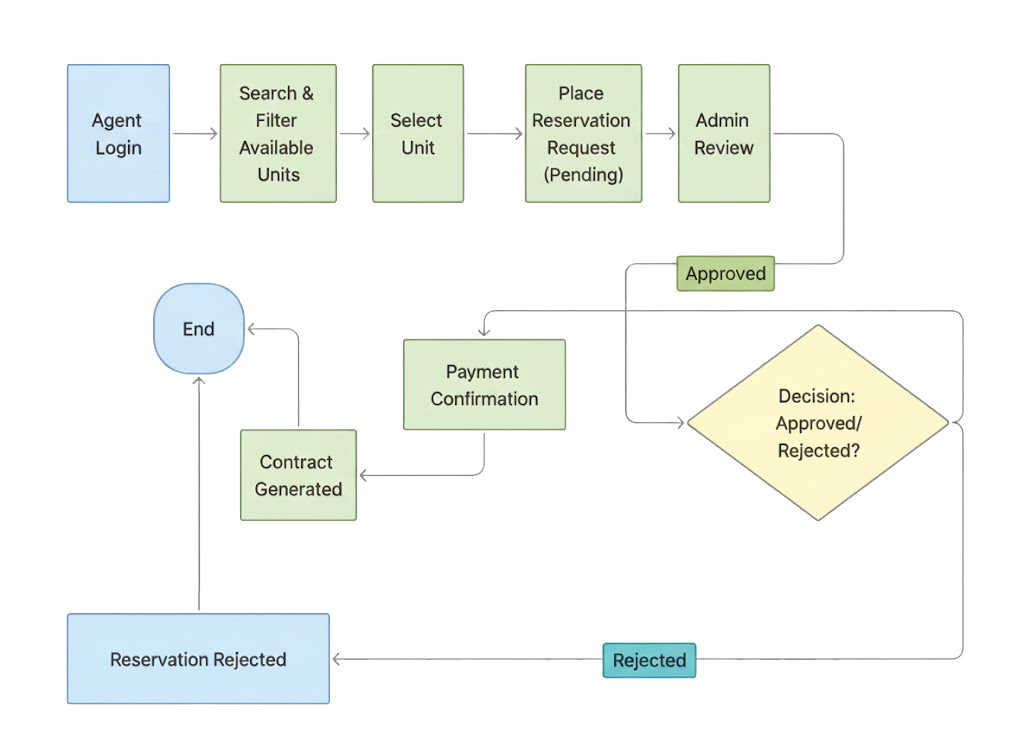
User Flow: This step led to the creation of a dedicated Sales Workflow to ensure smooth property reservation and payment processing, identifying all necessary system inputs and outputs.
3. User Experience and Interface Design (Step 3)
Design Focus: The design team focused on the high-stakes Mobile App reservation flow.
Usability Testing: We conducted early Usability Testing on low-fidelity prototypes for the Mobile App checkout process to optimize payment security notifications and minimize drop-off rates. This iterative testing resulted in a 15% improvement in conversion during the prototyping phase.
4. Technology Stack and Architecture Selection (Step 4)
Architecture: To handle high concurrency (many agents reserving units simultaneously), the Microservice with Kubernetes architecture was selected to ensure independent scalability and high availability.
Tech Stack: Flutter was chosen for the Mobile App for efficient cross-platform development, while Angular and NodeJS were selected for the robust Backend and APIs, utilizing a PostgreSQL Database for transactional integrity.
| Module | Primary Technology | Rationale |
| Backend | Angular, NodeJS for Server APIs | Robust interface and high-performance API processing. |
| Mobile App | Flutter | Efficient cross-platform development from a single codebase, reducing development time. |
| Architecture | Microservice with Kubernetes | Ensures independent scalability and easy load management for high transaction volumes. |
5. Detailed Project Roadmap and Planning (Step 5)
Execution: The roadmap was structured into Agile Sprints. The Backend Admin System was prioritized first (Sprints 1-3) to ensure data stability and API readiness before the front-end interfaces were fully built.
Risk Mitigation: A key risk—data synchronization between the Mobile App and the Backend—was addressed by defining clear API standards (Step 4) and integrating a real-time notification service (a Definition of Done requirement) to guarantee all sales agents saw updated stock instantly, preventing double bookings.
The Web Project Planning Process is not merely an optional step—it is the indispensable blueprint that determines the outcome of any digital solution. By systematically executing the five core steps—from defining the initial Vision and Scope to finalizing the Detailed Roadmap—organizations can proactively mitigate risks, control costs, and ensure alignment between technical execution and business goals.
For businesses seeking a reliable partner to navigate this critical planning phase, leveraging expert developers is essential. SEA, as a leading Vietnam software development company, utilizes this rigorous planning methodology to deliver high-quality, scalable web applications that transform complex ideas into market-ready successes. Investing in thorough planning is the most effective way to secure project success from day one.
Contact SEA today for a free consultation on your project!
Tags:
Vietnam Software Outsourcing, Web project planning process, Web application planning, 5 steps for web success, MVP planning, Software development roadmap, Agile planning tools, Tech stack selection, Web project initiation, UX/UI planning, Vietnam software development