
Enterprise Blockchain Ecosystem Guide: Public vs. Private Chains
Building a scalable Enterprise Blockchain Ecosystem is the most critical technical decision global business leaders face in 2026. As decentralized ledgers mature beyond early experimental phases, organizations are aggressively moving from basic proof-of-concepts to full-scale digital transformations. Today, decentralized technology serves as the primary engine for securing global supply chains, automated cross-border settlements, and Real-World Asset (RWA) tokenization.
However, navigating the structural differences between an open, public infrastructure and a restricted, private network requires a careful balance of security, speed, and privacy. To understand the broader market dynamics and talent landscape behind these architectures, you can explore our comprehensive analysis on Blockchain Outsourcing Vietnam: Key Trends & Advantages.
Before mapping out your integration strategy, let’s break down how these two foundational ledger types operate in a modern corporate environment.
Table of Contents
1. The 2026 Landscape: Architecting a Modern Enterprise Blockchain Ecosystem
By 2026, the discussion around distributed ledger technology (DLT) has completely shifted. Enterprises are no longer questioning the viability of the technology; instead, the focus has moved toward execution parameters: scalability, strict regulatory compliance, and cross-chain interoperability.
The early days of blockchain development were plagued by the “Blockchain Trilemma”—the belief that a network could not achieve decentralization, security, and scalability simultaneously. Modern advancements in Layer-2 scaling solutions, zero-knowledge proofs (ZKPs), and consensus mechanisms have fundamentally altered this paradigm.
Modern enterprise deployments heavily prioritize protocols that can handle high transaction throughput while maintaining strict data integrity. Whether you are launching a decentralized application (dApp) for customer loyalty or anchoring high-value financial assets, your choice of network architecture will dictate your operational costs, system security, and governance model for years to come.
2. Public Ledgers within an Enterprise Blockchain Ecosystem
Public blockchains—such as Ethereum Layer-2 solutions (Arbitrum, Optimism), Solana, or the Stellar Network—are entirely decentralized and permissionless. When integrated into an Enterprise Blockchain Ecosystem, they provide a layer of universal validation where anyone can join the network, spin up a node, read the ledger data, and execute transactions without a central authority governing entry.
Technical Mechanisms & Governance
Public networks utilize decentralized consensus algorithms like Proof of Stake (PoS) or Proof of History (PoH) to achieve state agreement across thousands of global validators. Governance is typically executed through decentralized autonomous organizations (DAOs) or open-source community consensus. Changes to the core protocol require a majority agreement among network participants, making public chains highly resistant to sudden or arbitrary modifications by a single entity.
Key Advantages:
True Immutability: Because the network is validated by thousands of independent, geographically dispersed nodes, altering historical records is mathematically next to impossible. Once a transaction is written to the main execution layer, it is finalized permanently.
Global Interoperability: Public networks inherently connect to a vast, pre-existing Web3 infrastructure. This ecosystem makes them ideal for digital assets, open financial protocols, and instant global remittance.
Zero Single Point of Failure: System uptime is guaranteed by the network’s decentralized nature. Even if half of the world’s validating nodes go offline, the remaining nodes continue to process state transitions without a centralized corporate data center failure.
Open Innovation: Developers can leverage thousands of open-source smart contract legos (composable building blocks) to launch new features rapidly without needing permission from a third-party gateway.
Key Drawbacks:
Data Transparency: All transaction metadata, wallet balances, and smart contract interactions are completely visible on a public ledger. While user identities are pseudonymous, automated on-chain analytics make it easy to map corporate asset flows and track transaction histories.
Fluctuating Operational Costs: Transaction fees (gas fees) can rise significantly during periods of heavy network congestion. Even though layer-2 scaling solutions have minimized this issue, public infrastructure remains subject to open market supply-and-demand forces.
Upgradability Friction: Modifying a live, bug-ridden smart contract on a public chain requires complex proxy patterns or hard-fork migrations, which can introduce friction into traditional enterprise software development lifecycles.
3. Private Frameworks inside an Enterprise Blockchain Ecosystem
Private or permissioned blockchains—such as Hyperledger Fabric, Corda, or private enterprise Ethereum instances (Quorum)—restrict network access exclusively to known, verified participants. Within an Enterprise Blockchain Ecosystem, this architecture functions as an exclusive digital club, where an administrative body or an enterprise consortium determines who can read the ledger, submit transactions, or act as a validating node.
Technical Mechanisms & Governance
Private networks replace heavy cryptographic mining or staking algorithms with high-speed, consensus protocols such as Practical Byzantine Fault Tolerance (PBFT), Raft, or Istanbul Byzantine Fault Tolerance (IBFT). Governance is entirely top-down. The consortium defines the operational rules, sets membership permissions, and can collectively agree to alter ledger states if an internal error occurs or regulatory requirements demand a transaction reversal.
Key Advantages:
- Absolute Data Privacy: Granular access controls ensure that sensitive corporate data, trade secrets, and client identities are encrypted and visible only to authorized counterparties. Features like Hyperledger Fabric’s “private data channels” allow companies to transact confidentially on a shared ledger.
- High Throughput and Performance: Since consensus involves fewer, highly optimized, trusted nodes, transaction processing speeds are exceptionally fast. Private networks can easily process thousands of transactions per second (TPS) with sub-second latency.
- Predictable Overhead: Operating costs are fixed and deterministic. Network participants do not rely on fluctuating public gas markets or external token economics, making long-term budgeting straightforward.
- Regulatory Compliance: Private frameworks are built to align with stringent compliance frameworks like HIPAA, GDPR, and anti-money laundering (AML) protocols. The network operator retains full control over data residency and identity validation.
Key Drawbacks:
Centralization Vulnerabilities: Because the network relies on a limited number of validating nodes, it faces higher risks of data manipulation if a core group of consortium members colludes to alter records.
Limited Ecosystem Reach: Private chains operate within isolated networks. Interacting with external Web3 liquidity pools, decentralized oracles, or public financial protocols requires building custom, highly secure cross-chain bridges.
Vendor Lock-in and Setup Complexity: Establishing a private blockchain consortium requires extensive upfront investment, complex legal frameworks between participating entities, and reliance on specialized enterprise software environments.
4. Deep-Dive Comparative Matrix
To help your technical architecture team make an informed decision, let’s look at a granular engineering breakdown comparing public and private distributed ledgers:
| Technical Metric | Public Blockchain Infrastructure | Private Permissioned Framework |
| Access Control | Permissionless (Open to all global actors) | Permissioned (Authorized entities only) |
| Data Visibility | Publicly readable via open block explorers | Restricted via cryptographic keys and channels |
| Transaction Throughput | Scaled via L2 (500 – 5,000+ TPS) | Exceptionally High (10,000+ TPS) |
| Network Latency | Seconds to minutes depending on finality | Sub-second deterministic finality |
| Consensus Mechanism | Proof of Stake (PoS), Proof of History (PoH) | PBFT, Raft, IBFT, Crash Fault Tolerance |
| Cost Model | Pay-per-transaction (Dynamic gas market) | Infrastructure hosting and node maintenance fees |
| Immutability Strength | Absolute (Guaranteed by global cryptographic network) | Relative (Guaranteed by consortium agreement) |
| Primary Use Cases | DeFi, Global Payments, RWA Tokenization | Supply Chain Tracking, Inter-bank Settlement, Healthcare |
5. Architectural Hybrids: Expanding the Enterprise Blockchain Ecosystem
As we look at production environments in 2026, the boundaries between public and private chains have begun to blur. Forward-thinking enterprises are increasingly adopting Hybrid Blockchain Solutions to capture the benefits of both architectures.
A hybrid model allows an organization to run a private, permissioned network for internal operations, asset tracking, and confidential data storage, while periodically anchoring a cryptographic hash of that data onto a public network like Ethereum. This technique validates the authenticity and immutability of corporate records to external auditors without exposing the underlying sensitive data.
Similarly, Consortium Blockchains allow multiple distinct organizations in the same industry (e.g., global shipping lines, customs agencies, and trade banks) to share a semi-private ledger. No single company controls the ecosystem, but the ledger remains closed to the general public, striking a balance between collaborative decentralization and industry privacy.
6. Decision Framework: Evaluating Your Enterprise Blockchain Ecosystem Needs
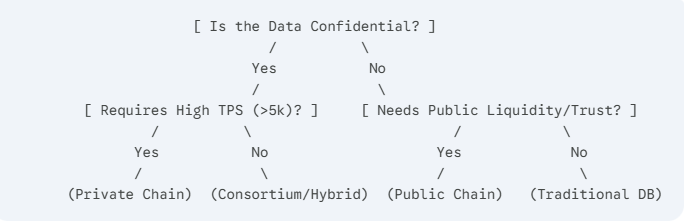
To determine which framework fits your specific corporate goals, evaluate your upcoming software project against these four fundamental pillars:
Pillar 1: Data Privacy and Regulatory Mandates
If your product deals with Protected Health Information (PHI), Personally Identifiable Information (PII) subject to GDPR, or confidential corporate trade agreements, a private network or an advanced hybrid system utilizing Zero-Knowledge Proofs is mandatory. If public verification is your primary goal, a public layer is ideal.
Pillar 2: Transaction Volume and Speed Needs
Analyze your transaction throughput requirements. If your business model involves millions of micro-transactions per hour that require instant, sub-second settlement (such as internal IoT sensor data validation), a private ledger or a highly specialized app-chain offers the performance required to prevent system bottlenecks.
Pillar 3: Ecosystem Interoperability
Does your asset need to interact with the global market? If you are launching a digital asset that must tap into public capital, trading platforms, or existing decentralized web wallets, building on a public ecosystem ensures instant compatibility. If the system is purely collaborative between known partners, prioritize a permissioned chain.
For companies looking to select an engineering team capable of navigating these complex structural decisions, we have detailed the industry’s best evaluation practices in our guide on How to Choose the Right Blockchain Outsourcing Partner in 2026.
7. Integration Strategies: Merging Web3 with Legacy Systems
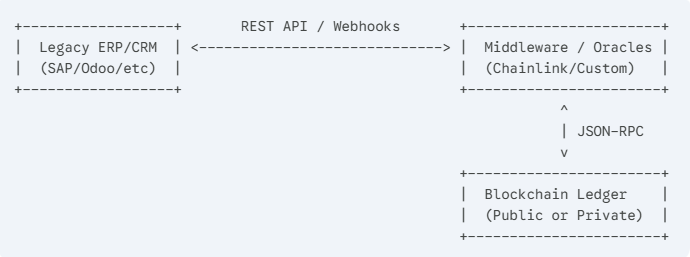
Choosing an ecosystem is only half the battle; the real engineering challenge lies in integration. A successful blockchain deployment must seamlessly communicate with your existing corporate technology stack.
API Middleware Layers
Directly connecting a legacy Enterprise Resource Planning (ERP) platform like SAP or Oracle to a blockchain ledger can create severe performance mismatches. Experienced software architects utilize API middleware layers. These systems listen for on-chain events, format the decentralized data packages into clean JSON formats, and trigger standard REST APIs or webhooks within your traditional corporate databases.
Decentralized Oracles
Smart contracts cannot natively fetch external data from the real world. To pull in current exchange rates, shipping logistics statuses, or legacy database inputs, your system requires a secure oracle network. Selecting and configuring trustworthy oracle feeds is critical to prevent malicious data from compromising your smart contract logic.
Building a sustainable, future-proof Enterprise Blockchain Ecosystem requires a deep understanding of both decentralized protocols and legacy system alignment. It is not an isolated experiment but a sophisticated evolution of corporate infrastructure. If you are exploring regional talent hubs to execute this vision smoothly, you can review our curated list of the [Top 15 Blockchain Development Outsourcing Companies in Vietnam] to benchmark the region’s top technical capabilities.
For businesses seeking a seasoned partner to navigate these architectural complexities, SEA-Solutions stands out as a trusted pioneer in the vietnam software outsourcing sector. With two decades of software engineering history since our founding in 2006, our engineering teams combine enterprise-grade project discipline with cutting-edge Web3 proficiency.
Whether your business logic demands the open transparency of public protocols like Stellar and Ethereum or the secure privacy of permissioned frameworks like Hyperledger Fabric, we deliver world-class vietnam software development services designed to scale your business into the future.
Contact SEA-Solutions Today for a Strategic Technical Consultation
Tags:
Enterprise Blockchain Ecosystem, Public vs Private Blockchain, Vietnam Software Outsourcing, Vietnam Software Development, SEA-Solutions, Hyperledger Fabric, Ethereum L2, Smart Contract Security, Web3 Architecture, IT Consulting 2026