
Offshore Development Team Setup: Timeline Guide
An offshore development team setup typically takes anywhere from a few weeks to several months, depending on team size, technical requirements, developer availability, and the hiring model you choose. A small team using common technologies can often be assembled relatively quickly, while a larger team requiring senior or specialized engineers will usually take longer.
The process involves much more than recruiting developers. Businesses need to define requirements, select an outsourcing partner, interview candidates, establish development environments, onboard engineers, transfer product knowledge, and create effective communication processes.
For companies considering Vietnam, understanding each stage of the setup process makes it easier to create a realistic launch timeline and avoid rushing important hiring decisions.
This guide explains the typical offshore development team setup timeline and how businesses can accelerate the process without sacrificing engineering quality.
Table of Contents
What Is an Offshore Development Team?
An offshore development team is a group of software professionals located in another country who work remotely on your software products or projects.
Depending on your requirements, the team may include:
- Front-end developers
- Back-end developers
- Mobile developers
- QA engineers
- DevOps engineers
- UI/UX designers
- Business analysts
- Technical leads
- Project managers
Unlike short-term project outsourcing, an offshore team can operate as an extension of your internal engineering organization.
This model is particularly suitable for SaaS products, digital transformation programs, enterprise applications, and businesses requiring continuous software development.
How Long Does Offshore Development Team Setup Take?
There is no universal timeline because every project requires a different combination of technologies, experience, and team structure.
However, a typical offshore development team setup can be divided into five stages:
| Stage | Indicative Timeline |
|---|---|
| Requirements & team planning | 2–5 business days |
| Partner selection & preparation | 3–10 business days |
| Recruitment & technical interviews | 1–4+ weeks |
| Onboarding & environment setup | 3–10 business days |
| Knowledge transfer & initial ramp-up | 1–3+ weeks |
These ranges are indicative rather than guaranteed. Some developers may already be available within an outsourcing provider, while highly specialized roles can require a significantly longer recruitment process.
A small team using common technologies could therefore begin development within several weeks. Building a large multidisciplinary team from scratch may take considerably longer.
Stage 1: Define Your Offshore Development Team Setup
Before recruiting anyone, define what the team actually needs to accomplish.
Start by documenting:
- Product objectives
- Technology stack
- Required roles
- Developer seniority
- Initial team size
- Expected project duration
- Working-hour requirements
- Communication expectations
- Security requirements
- Budget
For example, a SaaS product might initially require two full-stack developers, one QA engineer, and a technical lead.
An enterprise modernization project may require additional cloud, DevOps, architecture, security, and business analysis expertise.
Clear requirements make recruitment faster because potential partners can immediately identify suitable candidates.
Stage 2: Choose the Right Offshore Development Team Setup Model
The next step is deciding how the offshore team will operate.
Businesses typically choose between direct recruitment, staff augmentation, project outsourcing, and dedicated development teams.
For long-term product development, a dedicated team is often attractive because engineers work continuously on the product and retain knowledge over time.
Project-based outsourcing may be more appropriate when the requirements, scope, budget, and delivery date are clearly defined.
Choosing the wrong model can create unnecessary delays later if the project needs greater flexibility than the original contract allows.
Stage 3: Recruitment in the Offshore Development Team Setup Process
Recruitment is often the most variable part of the offshore development team setup timeline.
Common technology roles may be filled relatively quickly, particularly when the outsourcing provider already has suitable engineers available.
Recruiting highly specialized developers can take longer.
Factors affecting recruitment time include:
- Technology stack
- Required seniority
- Number of developers
- English communication requirements
- Industry experience
- Security requirements
- Salary expectations
- Candidate availability
Technical interviews also require time.
Companies should avoid shortening the hiring process simply to meet an aggressive launch date. Selecting the wrong developers can create far greater delays through poor quality, turnover, or repeated recruitment.
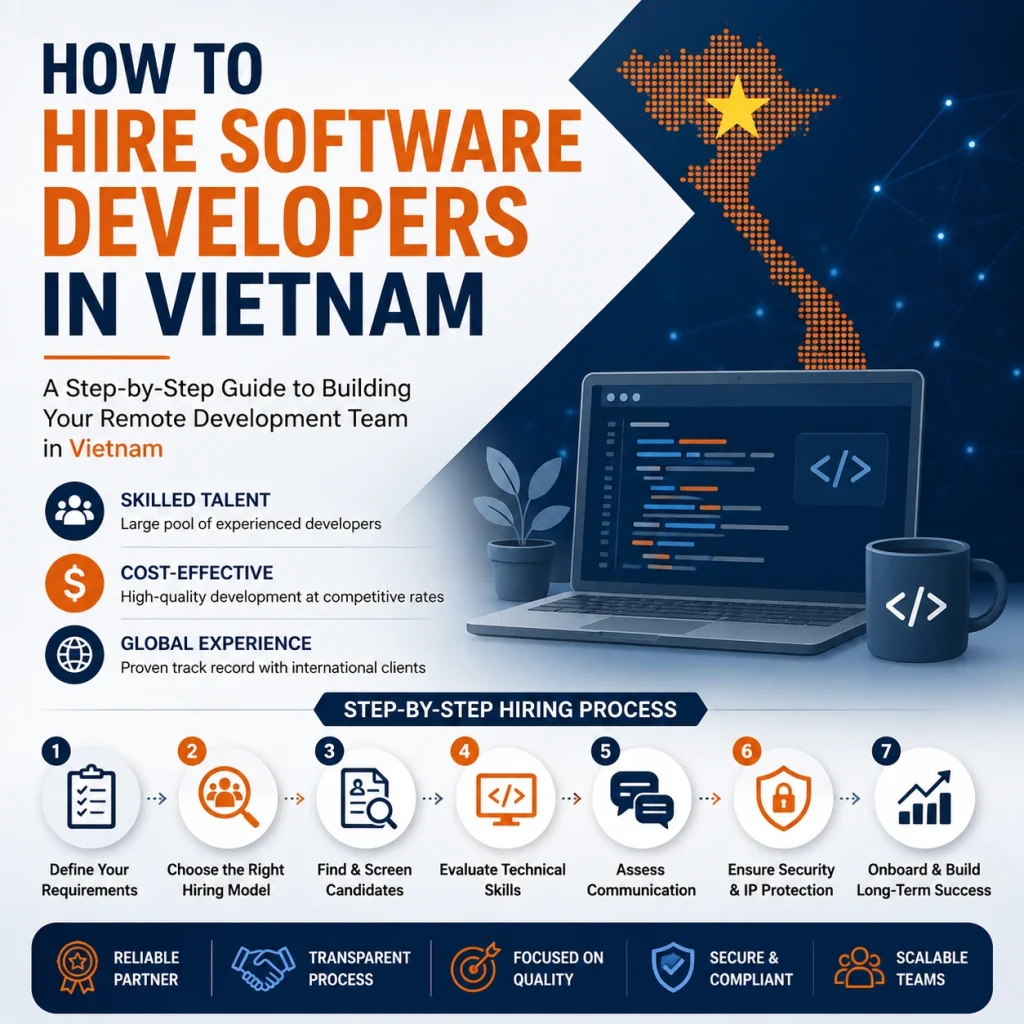
Offshore Development Team Setup in Vietnam
Vietnam can be particularly attractive for businesses looking to build offshore engineering capacity because of its growing software development workforce and established outsourcing sector.
There are two main approaches.
Businesses can recruit developers directly and manage employment, HR, infrastructure, and retention themselves.
Alternatively, they can work with a Vietnamese software development partner that manages recruitment and team administration while the client focuses on product direction and engineering delivery.
The second approach can reduce setup complexity, especially for organizations without an existing legal or operational presence in Vietnam.
Stage 4: Onboarding in Your Offshore Development Team Setup
Recruitment is not the end of the setup process.
Once developers join, they need access to the tools and information required to work effectively.
Typical onboarding activities include:
- Creating company accounts
- Repository access
- Development environment configuration
- VPN and network access
- Project management tools
- Communication platforms
- Coding standards
- Security policies
- Product documentation
Security permissions should follow the principle of least privilege. Developers should receive the access required for their responsibilities without unnecessary access to unrelated systems or data.
Well-prepared companies can complete much of this work before the developer’s first day, reducing idle time during onboarding.
Stage 5: Knowledge Transfer During Offshore Development Team Setup
Even experienced developers need time to understand an existing software product.
Knowledge transfer may cover:
- System architecture
- Business rules
- Existing source code
- Database structure
- APIs and integrations
- Deployment processes
- Known technical debt
- Current roadmap
- Customer requirements
This means there is an important difference between team launch and full productivity.
A team may officially begin working within several weeks but still require additional time to reach its expected delivery velocity.
Trying to eliminate this ramp-up period can increase mistakes and technical debt.
What Can Delay Offshore Development Team Setup?
Several factors can extend the timeline.
Specialized Technical Skills
AI, cybersecurity, cloud architecture, DevOps, and other specialist roles may have smaller candidate pools.
Large Initial Team Size
Recruiting ten developers at once will usually take longer than launching with three and scaling gradually.
Slow Interview Decisions
Strong candidates may receive multiple offers. Long delays between interviews and hiring decisions increase the risk of losing them.
Unclear Requirements
If the required technologies, seniority, or responsibilities keep changing, recruitment becomes difficult.
Security and Compliance
Organizations operating in regulated environments may require additional background checks, security configuration, access approvals, and compliance procedures.
How to Speed Up Offshore Development Team Setup
Faster does not need to mean lower quality.
Companies can shorten the setup process by preparing requirements before recruitment begins and making hiring decisions quickly.
Other useful strategies include:
- Start with a small core team
- Prioritize critical roles first
- Prepare interview criteria in advance
- Use structured technical assessments
- Prepare accounts and environments early
- Document architecture and development processes
- Assign an internal product owner
- Establish communication routines before launch
Starting with a core team is particularly effective. Additional developers can be added after the initial engineers understand the product and development process.
Don't Ignore the Hidden Cost of Rushing
Businesses sometimes try to reduce setup time by hiring the first available developers.
This can create expensive problems later.
Poor candidate selection may lead to developer replacement, repeated onboarding, rework, communication problems, and knowledge loss.
These expenses may not appear in the original recruitment budget but can significantly increase the total cost of offshore development.
How Much Does an Offshore Development Team Cost?
Timeline and cost are closely connected.
Team size, developer seniority, technology stack, project duration, QA requirements, DevOps support, and management structure all influence the monthly budget.
Businesses should also distinguish between developer rates and total team costs.
A complete team may require QA, project management, DevOps, infrastructure, and other supporting capabilities in addition to software developers.
Offshore Development Team Setup Checklist
Before launching your offshore team, confirm that you have:
- Defined the required roles
- Selected the engagement model
- Established a realistic budget
- Defined technical interview criteria
- Assigned an internal product owner
- Prepared development environments
- Configured security access
- Prepared technical documentation
- Defined communication channels
- Established Agile or delivery processes
- Planned knowledge transfer
- Defined initial performance expectations
Preparation in these areas can significantly reduce delays after developers are hired.
A successful offshore development team setup is not simply about recruiting developers as quickly as possible.
For many projects, a small core team can begin working within several weeks, while larger or highly specialized teams may require considerably more time to recruit, onboard, and reach full productivity.
The most important factors are preparation, clear requirements, fast but thorough candidate evaluation, structured onboarding, and effective knowledge transfer.
Companies building teams in Vietnam should also consider long-term factors such as developer retention, communication, security, scalability, and product knowledge.
By treating offshore development team setup as a structured process rather than a rushed recruitment exercise, businesses can build teams that not only launch successfully but continue delivering value as their products grow.
Contact SEA-Solutions Today for a Strategic Technical Consultation
Tags:
Software Outsourcing, Offshore Development Team, Offshore Development Team Setup, Dedicated Development Team, Vietnam Software Developers, Offshore Software Development, IT Outsourcing, Vietnam Software Outsourcing